What is a dramaturgy blog?

This blog will serve as a source of research and information for the cast and crew of GPAC's Ragtime. Each post will address specific topics or areas of interest presented in the show. Dramaturgy is meant to highlight the historical, social, political, and economical context of the play as well as answer any questions presented by the cast and crew. Instead of printing packets of information for the cast, this online blog will allow me to continuously share research, pictures, video, music, etc - without wasting any paper! The blog will constantly be updated and under construction so feel free to email me about specific topics: JoanMarieHurwit@gmail.com.
Showing posts with label Props. Show all posts

Friday, June 17, 2011

Staging Rehearsal Friday, June 17th

TRAIN CONDUCTOR in "Not in the City"
Gum vs. Chewing Tobacco
Both were invented and popular at the turn of the century but neither were common in professional settings. Parlors and passenger cars even had spittoons for uses to dispose of their chewing tobacco, but I’m uncertain whether a train conductor would be demonstrating casual behavior on-duty. Unless we think New Rochelle is lax about it.

GRANDFATHER, 1:12-13
What is he doing?  Hobby or Habit?
 

HABIT Cigars – they were invented and popular, just starting to be manufactured commercially, but its effects were also known. Heavy smoker President Ulysses S. Grant was diagnosed with oral cancer in 1884; he was the only president to die of cancer.
 

Smoking Pipe – Available and common

HOBBY 
Stamp Collecting –The first postage stamp, the Penny Black, was issued by Britain in 1840 and pictured a young Queen Victoria. People started to collect stamps almost straight away, one of the earliest and most notable was John Edward Gray. In 1862 Gray stated that he "began to collect postage stamps shortly after the system was established and before it had become a rage." As the hobby and study of stamps began to grow stamp albums and stamp related literature began to surface and by the early 1880s publishers like Stanley Gibbons made a business out of this advent. Children and teenagers were early collectors of stamps in the 1860s and 1870s. Many adults dismissed it as a childish pursuit but later many of those same collectors, as adults, began to systematically study the available postage stamps and publish books about them. Stamp collecting is a less popular hobby today than it was in the early 20th century, but today it is estimated that about 25 million people enjoy the hobby in the United States, while worldwide the estimated numbers of stamp collectors is around 200 million. Today, though the number of collectors is somewhat less, stamp collecting is still one of the world's most popular indoor hobbies.
 
Coin Collecting – During the 19th and 20th centuries, coin collecting increased further in popularity. The market for coins expanded to include, not only antique coins, but foreign or otherwise exotic currency. Coins shows, trade associations and regulatory bodies emerged during these decades.

Wednesday, June 1, 2011

The Typewriter

I already mentioned some basic history about the typewriter in the previous post, but here are some photographs to check out.

This is the Hansen Writing Ball -- 1870, the first typewriter manufactured commercially.


This is the Prototype of the Sholes and Glidden typewriter, 1873, the first commercially successful typewriter, and the first with a QWERTY keyboard. This was not a small, easily transferable object.

However, by 1910, mechanical (or manual) typewriters were fairly common, fully equipped with a type bar -- what you see below.  It was significant because it introduced the shift key, and soon in 1917, a noiseless design enabling the typist to type quietly. Commercially, and ironically, it didn't sell very well. Customers seemed to prefer it's "clickity-clack."

Friday, May 27, 2011

What is The Little Girl playing with on the ship?

A box that she has keepsakes in, maybe it was an old cigar box...
http://image0-rubylane.s3.amazonaws.com/shops/annasantiques/8666.1F.jpg 
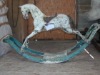
...a handmade wooden wagon, miniature rocking horse, carved dog...
http://www.icollector.com/images/1067/11266/11266_967803_1_sm.jpg


http://www.quintessentia.com/media/catalog/product/cache/1/small_image/126x161/5e06319eda06f020e43594a9c230972d/1/5/15274.jpg
http://i00.i.aliimg.com/photo/v0/240478066/Lines_Bow_circa_1900_Rocking_Horses.summ.jpg


...or a wooden dreidle if it was the only thing they could manage to bring.
http://www.pasarel-art.com/Picture.aspx?width=200&height=200&id=5004588
Dolls were very common, and with Teddy Rosevelt in office, Teddy Bears became a fast favorite.
http://thumbs2.ebaystatic.com/m/mfDZFXAju4A1yGJNGwsuBqw/140.jpg 
http://www.antiquetoychest.com/wp-content/uploads/2010/09/teddy-bear.jpg 
These are examples of toys popular in the early 1900s that The Little Girls would have never had the money to have, it is possible however that The Little Boy might have owned them.

http://www.juliaauctions.com/auctions/archived/toy/jun01/pict0028.jpg


The Emergence of the Camera

The first photograph was taken c.1817, however the photographs were not permanent and eventually faded away.  In 1827, photographs were taken by coating a pewter plate with bitumen and exposing the plate to light. Where the light struck, the bitumen hardened, thus making the unhardened area dissolve away.

In the 1840s and 50s, camera makers experienced with different types of plates, and in the 1870s wet plates soon rivaled dry plates in speed and quality.  Shortened exposure time which made candid photography possible (ie. paparazzi), necessitated another innovation: the mechanical shutter. By the turn of the century, built-in shutters were common for each camera. 

This is the "Victo" -- short for the Victorian plate camera.
http://www.historiccamera.com/librarium/victo/victo_image1.gif
The Century Camera, founded in 1900.
http://farm4.static.flickr.com/3340/3670626378_ba7c2e0b76.jpg

This is the Brownie and the Yale camera, circa 1900. George Eastman's first camera, the Kodak .2 Brownie Box camera, offered a fixed-focus lens and single shutter speed. First offered for sale in 1888, it was a huge hit with consumers because it was a new and exciting invention for a relatively low cost. It came pre-loaded with film for 100 exposures and introduced the concept of the snapshot, soon leading to the movie camera. 
https://blogger.googleusercontent.com/img/b/R29vZ2xl/AVvXsEhGz-gMsR6BTRKN4UyHYQgnjxfaJfixwnKT3pGizJsN8VsG8JpUcH7CmTvBIqVFRtDEmG2gMTnIvpqiJZ1HC6UH9BQ1NFJnhhxilY8_2D31C6GQ3b658yyTI-YaWzH9ZmJ1s4C-8WmazoSS/s1600/696px-Brownie2_overview.jpg http://www.photographyhistory.com/CS03/Yale1900.jpg
Here's an advertisement for children to own cameras of their own.
http://smarthistory.org/assets/images/images/KodakBrownie_advert.jpg

Props for Act 1, Scene 2

If the Brother needs a prop, I thought it was very interesting to find out that ships in bottles were common toys at the turn of the century.  What an appropriate prop!
http://www.la-timonerie-antiquites.com/uploads/items/detail/c7c3c1fae2374a44b8acc2d631f57edecdcee7c7.jpg
This is an advertisement for binoculars in the early 1900s and an example of such binoculars. Definitely a prop that Father would take much pride in.

http://i.ebayimg.com/00/$(KGrHqF,!iME1N2w1YE+BNf!GTozig~~_35.JPGhttp://www.crescentcityauctiongallery.com/images/Nov152008/thumb/66.jpg He would also have a pocket watch and a high end piece of luggage.

http://www3.sympatico.ca/michael332/sun.jpg
 http://www.la-belle-epoque.net/images/bag_0016.jpg http://ny-image3.etsy.com/il_fullxfull.122782907.jpg
If for any need we need to further establish the ship, we can roll on one of these...
http://t3.gstatic.com/images?q=tbn:ANd9GcR6ZXkmUKXiwBV-GbPPG-X4LKLfrbLcrRxj9J5U86moDuGa0kDw